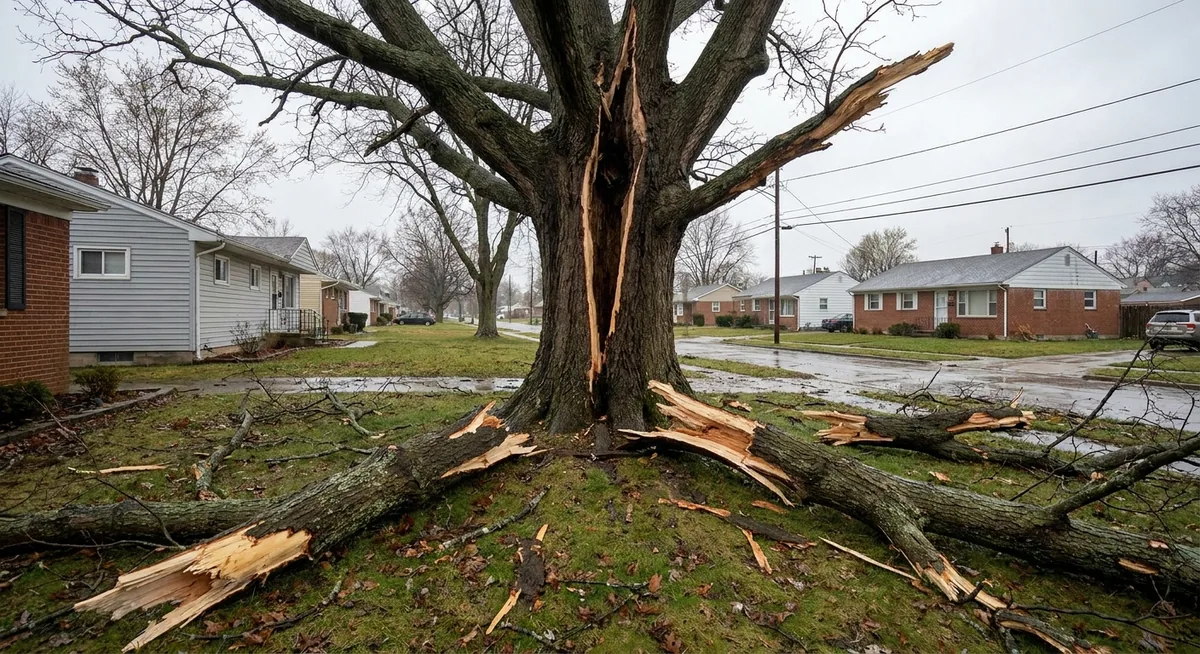
After a storm, the question most homeowners are stuck on isn’t “what happened” — it’s “what do I do now?” If a large tree in your yard is still standing but clearly took damage, you’re facing a decision that feels higher-stakes than it should. Do you spend money removing a tree that might be fine? Or do you leave it and end up with a bigger problem?
This post is about how to read the damage and separate what looks bad from what’s actually dangerous. There’s a real difference between the two.
Signs a Storm-Damaged Tree Needs to Come Down
Some damage is recoverable. Other damage means the tree is structurally finished, and leaving it standing is a hazard waiting to happen. These are the signs that typically indicate removal is the right call:
Split or cracked trunk. A vertical split through the main trunk — especially one that goes deep into the wood — compromises the structural integrity of the whole tree. These don’t heal the way a cut on your arm does. They get worse over time as moisture gets in, rot sets in, and the split widens.
Major root heave or uprooting. If the storm partially uprooted the tree — you can see soil heaving up on one side, or the root collar is clearly lifted — the tree has lost its anchor. Even if it’s still standing, it’s no longer stable. Replanting a fully grown tree after this kind of event almost never works.
A significant new lean. If a tree that was perfectly vertical before the storm is now noticeably leaning — especially toward a structure — that lean happened because something gave way. It’s not a cosmetic issue.
Loss of more than half the canopy. A tree that’s lost the majority of its crown may not be able to generate enough energy through photosynthesis to sustain itself. There are exceptions depending on species and health, but it’s a threshold worth taking seriously.
Dead or broken top (leader). The central top of the tree plays an important role in its structure and long-term growth. A lost or severely damaged leader on certain tree species often means a misshapen, structurally weaker tree going forward. An arborist can tell you whether it matters for the specific species you’re dealing with.
Signs a Tree Can Recover
Not all storm damage is fatal. These are signs a tree may be worth saving:
Limb loss without structural damage. Trees can lose significant branches and still recover, especially healthy ones. The question is whether the damage is limited to the crown or whether it extends into the trunk structure.
Clean breaks. Limbs that snapped off cleanly, with no tearing into the trunk, leave a wound the tree can seal over time. Ragged tears that expose a lot of interior wood are harder on the tree but don’t automatically mean removal.
The main structure is intact. If the trunk is solid, the root system looks undisturbed, and the tree hasn’t shifted from its original position, there’s a reasonable chance the tree recovers — with proper pruning to remove the damaged material and reduce any remaining weight imbalances.
The tree is young and otherwise healthy. Young trees are more resilient and often recover from storm damage that would finish an older specimen. Health matters too — a vigorous tree handles trauma better than one that was already stressed.
When It’s Not Obvious
The genuinely hard cases are the ones that aren’t clearly in either category. A tree that lost a few large limbs but still looks structurally sound. A crack in the trunk that’s small right now. A lean that might be pre-existing or might have happened in the storm.
This is where a professional assessment is worth the call. An arborist can probe bark and wood to check for hidden rot, assess whether a lean is stable, and tell you whether a crack is superficial or goes deep. They can also help you weigh the risk against the cost of removal — sometimes a compromised tree over an empty corner of your yard is a low-priority situation, while the same damage near your house changes the calculus entirely.
If you’re in the gray zone, a tree health and arborist consultation is usually less expensive than guessing wrong in either direction.
Location Matters
The extent of the damage isn’t the only factor — location is equally important. A damaged tree that poses no threat to a structure, parked vehicle, walkway, or power line is a lower-risk situation than the same damage 30 feet closer to your house.
This is worth thinking through honestly. A split trunk over an empty side yard in Sylvania or Waterville is a different risk level than the same split trunk hanging over your bedroom window. The tree that can wait a few weeks in one location might need to come down today in another.
Don’t Assess a Damaged Tree Up Close
One practical safety note: when a tree has visibly shifted, uprooted, or split, don’t walk directly under it or stand close to the base to get a better look. Damaged trees can drop limbs or fall with very little warning, and the failure zones are exactly where you’d naturally walk to look.
Assess from a distance. Use binoculars if you have them. If you think the tree might be unstable, wait for a professional to get eyes on it before anyone gets close.
Frequently Asked Questions
How much damage is too much for a tree to recover from?
There’s no single answer — it depends on the species, the tree’s age and health going in, and what specifically was damaged. Structural damage to the trunk or root system is generally more serious than limb loss. When in doubt, have an arborist take a look before you decide.
Can a cracked trunk heal on its own?
Bark can compartmentalize wounds over time, but a deep structural crack doesn’t close and strengthen the way a surface wound does. Cracks typically worsen as moisture gets in and the wood cycles through seasons. A small crack now can become a serious structural problem in a few years.
Is it better to remove a questionable tree now or wait and see?
It depends on the risk. A questionable tree over an empty area of your yard is a lower-stakes wait-and-see situation. A questionable tree near your house, vehicles, or utility lines is a situation where the downside of waiting is significant. The cost of removal is usually far less than the damage a fallen tree can cause.
What’s the difference between topping and removing a storm-damaged tree?
Topping — cutting the crown down dramatically — is sometimes presented as a cheaper alternative to removal. It’s almost never a good idea. Topped trees grow back unpredictably, often with weaker branch structure than before, and the stress of the cut increases disease and pest susceptibility. If removal is the right call, removal is the right call.
What if only a few large limbs came down?
Limb loss alone, even significant limb loss, doesn’t necessarily mean the tree needs to come down. A qualified arborist or tree service can evaluate the remaining structure and prune out any remaining damaged or unbalanced material. See tree trimming and pruning services if that’s the situation you’re in.
If you have a storm-damaged tree you’re unsure about in the Toledo area, Glass City Tree Service can assess it and give you a straight answer. We handle tree removal when that’s what’s needed and arborist consultations when you just need a professional set of eyes. Call (419) 548-5543 — we respond quickly to storm-related calls across Northwood, Whitehouse, Maumee, and the rest of northwest Ohio.
If you’ve already confirmed the tree needs to come down and you’re dealing with an urgent situation, read about what to expect from emergency tree service. If the damage involves ice or happened during an ice storm specifically, ice storm tree removal in Toledo covers a few things that are different about that situation.