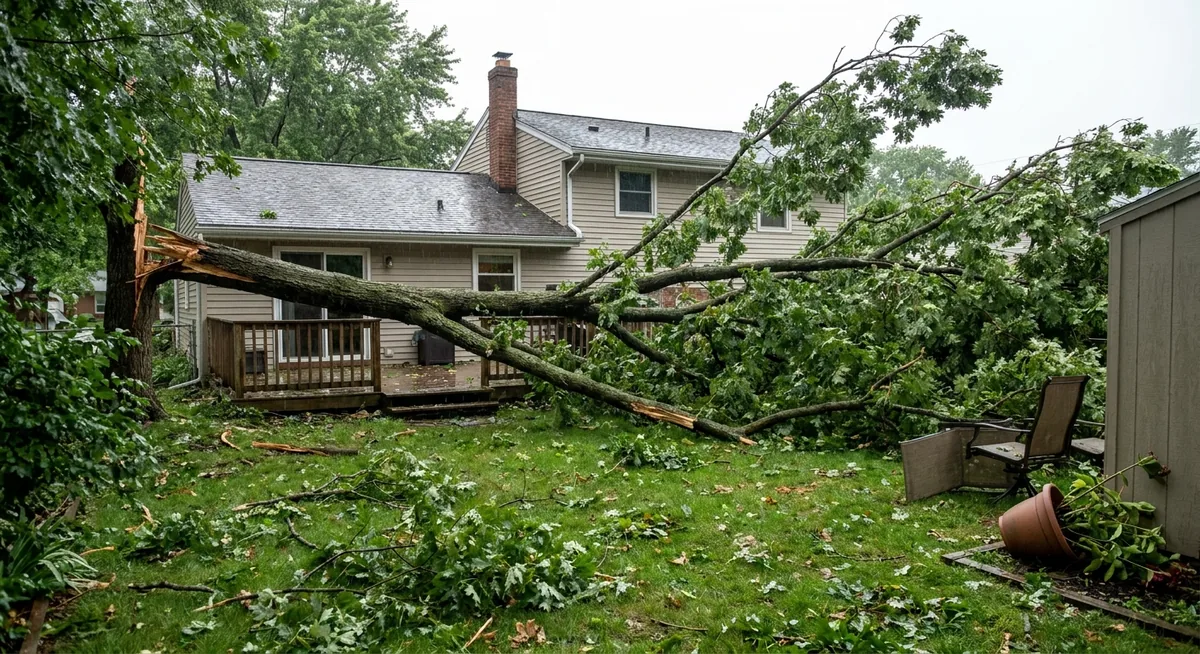
Northwest Ohio gets hit with serious weather. Severe thunderstorms in spring and summer, straight-line winds that can top 60 mph, and ice events in winter that bend full trees to the ground. After a storm passes, most homeowners step outside to a yard that looks like a disaster — and aren’t sure where to start.
Most storm damage, even when it looks overwhelming, is manageable. The key is knowing what needs immediate attention and what can safely wait a few days. Here’s how to work through it.
Do This First After a Storm
Wait until the storm has completely passed before going outside. It sounds obvious, but trees continue dropping limbs even after the main winds die down, sometimes for hours.
When you do head out, do a slow walk of your property from a safe distance first. You’re looking for obvious hazards: a tree or large limb resting on your house, a broken limb still hanging in a tree above a walkway or driveway, or anything in contact with a power line. If you see a downed line or a tree touching a line, stay well back and call Toledo Edison before you do anything else.
Take photos before anyone starts cutting. Your insurance company will want to see the damage as it happened, before cleanup begins. A quick walk-through video on your phone — narrating what you see — can save a lot of back-and-forth if you end up filing a claim.
What’s Urgent vs. What Can Wait
Not everything needs to be dealt with today. Here’s a rough guide:
Deal with immediately:
- Any tree or large limb resting on your house, garage, or fence
- Hanging limbs overhead in high-traffic areas — your front door, driveway, patio, or anywhere kids play
- A tree that has shifted or started leaning since the storm
- Anything involving a power line
Can wait a few days:
- Downed branches scattered across the lawn that are fully on the ground
- Limbs that broke off cleanly and aren’t hanging over anything
- Cosmetic bark damage on a tree that’s otherwise standing straight
- Debris blocking a side gate or non-essential access
The trees still standing are the priority. A branch that’s already on the ground isn’t going anywhere. A half-broken limb still suspended in the canopy is a different story — those can drop without warning, sometimes days after a storm.
Working With Your Insurance Company
If a tree or large limb landed on a structure you own — your house, garage, shed, or fence — call your homeowner’s insurance company before major cleanup begins. They may want to send an adjuster, and clearing everything first removes the documentation they need to process your claim.
Most standard policies cover damage to structures caused by falling trees, but don’t cover removing a tree that fell in your yard without hitting anything. Your agent can tell you quickly what applies to your situation.
Keep every receipt for storm-related tree work. If your policy covers removal costs, you’ll need documentation.
What a Storm Cleanup Crew Does
When a professional tree service crew shows up for storm cleanup, the first job is assessment — figuring out the safest order to work in and identifying anything that might be unstable. They’ll typically deal with the most dangerous material first.
From there, they’ll remove or limb out damaged trees, clear large debris, chip smaller branches, and haul everything away. A good crew will also flag any other trees on your property that took damage during the cleanup, so you know what to watch going into the next storm.
Larger jobs — multiple trees down or a tree that hit a structure — can take a full day or more. A job with a few downed limbs might wrap up in a couple of hours.
When to Call a Professional Instead of DIY-ing It
Small branches you can safely drag to the curb are a reasonable DIY project. Beyond that, the risk goes up fast.
Don’t try to handle it yourself if:
- A tree is leaning toward your house or any other structure
- A limb is lodged in another tree above your head
- The tree or limb is anywhere near a power line
- You’d need a ladder or a chainsaw to deal with it
Chainsaws under load tension can kick out unpredictably. Working at height without training is dangerous even in good conditions — after a storm, with unstable trees and slick ground, it’s worse. The cost of professional help is almost always worth it.
Frequently Asked Questions
How much does storm cleanup cost in Toledo?
It depends on the size of the job. Small cleanups with a few manageable downed limbs cost less than large removals or jobs involving a tree on a structure. Most companies will give you a free estimate — get a couple if the job is significant.
Can I do my own storm cleanup?
For small debris that’s on the ground and away from structures and lines, yes. For anything involving a chainsaw, height, a hanging limb, a leaning tree, or a power line — call a professional.
Will my homeowner’s insurance cover storm tree removal?
If a tree damaged a structure you own, most policies will cover it. If it fell in your yard without hitting anything, standard policies typically don’t cover removal. Call your insurance agent first to know where you stand before you start spending money.
How long does storm cleanup take?
Smaller jobs with a few downed limbs can be done in a few hours. A larger property with multiple damaged trees, or a situation where a tree hit a structure, can take a full day or longer.
What’s a widow-maker and why does it matter?
A widow-maker is a broken limb that’s still suspended in a tree, held up by other branches or bark. It looks like it’s not going anywhere, but wind, rain, or nothing at all can send it down without warning. Any hanging limb above a walkway, driveway, or play area should be treated as an active hazard.
Glass City Tree Service handles emergency tree service and storm cleanup throughout Toledo and the surrounding area, including Sylvania, Maumee, Perrysburg, and Bowling Green. If you’re not sure how serious something is, call us at (419) 548-5543 — we can usually help you figure out what’s urgent over the phone.
For more on what happens when you call for emergency service, see what to expect from emergency tree service after a storm.