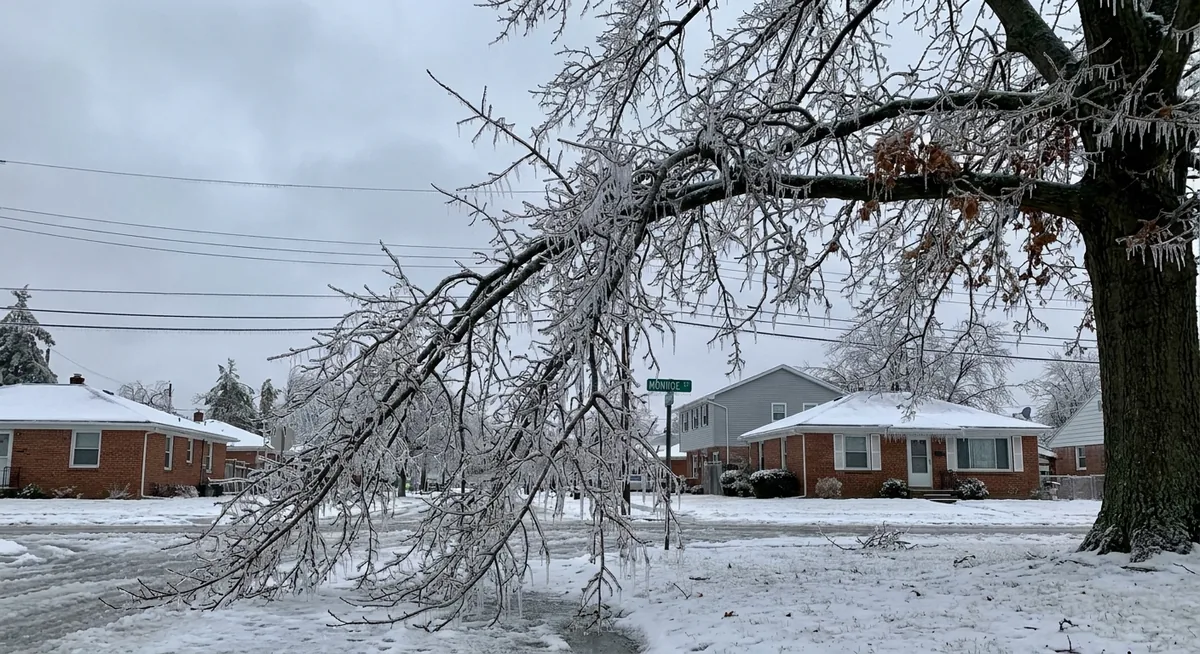
Toledo and northwest Ohio get a few ice storms every winter, and they’re genuinely different from the windstorm and thunderstorm damage that shows up in warmer months. The damage accumulates slowly, sometimes over hours, and it often creates situations that aren’t immediately obvious — trees that look stressed but intact during the storm can fail hours or even a day later once the ice shifts.
If you’ve got trees on your property and you’re watching ice build up on the branches, here’s what you actually need to know.
Why Ice Damage Is Different From Wind Damage
A severe thunderstorm snaps and breaks things all at once. An ice storm bends things gradually and then holds them there. That’s what makes ice events harder on trees — the sustained load, not a single impact.
Ice is heavier than most people realize. An inch of glaze ice on a large tree can add hundreds of pounds to individual branches. Branches that could handle that weight if it were spread over a short burst of wind can’t handle it held in place for 12 or 18 hours. The stress point shifts over time, which is why trees that look okay during a storm can fail hours after it ends.
That sustained load also means ice damage tends to involve more multiple-branch failures and structural splits than wind events, which typically snap single limbs. It’s common to come out after an ice storm and find that several trees across the property all have significant damage, rather than one or two that took a direct hit.
What NOT to Do During an Ice Storm
This is the most important section in this post, so it’s worth stating directly: do not go outside to knock ice off your trees while the storm is ongoing.
It’s a common instinct. The branches are bending toward the ground, it looks like the tree can’t handle any more, and shaking the branch seems like it would relieve the pressure. It does not work that way. The branch is already under maximum stress. Shaking it — or hitting it with a broom handle — can cause it to snap suddenly and unpredictably, potentially toward whoever is standing under it.
Similarly, don’t try to remove hanging limbs yourself while ice is still on them. Ice adds weight that makes it almost impossible to predict how the limb will move when cut or dislodged. That’s work for after the storm, when the ice is gone and conditions are safer.
Stay inside while the ice is falling. Come back out after it’s done.
Assessing Your Trees After the Ice Melts
Once the ice is fully gone — not just partially melted, but fully clear — walk your property from a safe distance and look for:
Branches that snapped off and are on the ground. These are a cleanup issue, not a current safety hazard.
Branches that partially broke but are still hanging. This is more serious. A limb that cracked but didn’t fall is hanging by bark or caught on other branches. It can drop at any point. Keep people and vehicles clear of the area until it’s been dealt with.
Trunks or major limbs that split. If ice weight opened a vertical crack in the trunk or a major branch junction, that damage doesn’t go away when the ice melts. It needs to be evaluated.
Any new lean. If a tree has shifted from its pre-storm position, even slightly, that’s significant. It means something in the root system or trunk gave way under the load.
Anything in the first category can wait. Everything else warrants a call to a professional tree service.
Which Trees Take Ice Damage the Worst in Our Area
Not all species handle ice loading equally. In northwest Ohio and the Toledo area, a few trees consistently have more problems:
Bradford pear. Common in suburban yards across Perrysburg, Sylvania, and Maumee. The branch structure is notoriously weak — tight, upright angles that fail under load. Bradford pears often lose major sections in every significant ice event.
Silver maple. A common street and yard tree in the area. Fast-growing, but the wood is relatively brittle. Large silver maples can lose major limbs in ice storms, and the root systems sometimes get stressed in hard freeze-thaw cycles.
Elm (remaining native specimens). Older elms that survived Dutch elm disease have wide-spreading canopies that catch a lot of ice load. They’re generally resilient, but large specimens can still drop significant material.
Young trees of most species. Young trees have smaller root systems and less structural mass to counterbalance ice weight. Newly planted trees are particularly vulnerable and may need to be re-staked after a significant ice event.
Evergreens — particularly arborvitae and yews — can also sustain significant shape damage from ice loading, though they’re less prone to catastrophic structural failure than most deciduous trees.
Ice-Damaged Trees Have Specific Hazards
The danger window for ice-damaged trees extends past the storm itself. A branch that cracked under ice load and is hanging by bark can drop hours later, once temperatures shift and the wood dries and contracts. This is different from wind damage, where most of the dangerous drops happen during the event.
For the first 24–48 hours after a significant ice event, treat any tree with visible ice damage as potentially unstable. Don’t park under them, and don’t let children play near them until you’ve had a chance to assess or have a professional take a look.
Frequently Asked Questions
How long after an ice storm should I wait before assessing my trees?
Wait until the ice is fully melted and the temperature is above freezing before doing a serious assessment. Frozen branches can make damage look worse than it is, and conditions while icy are still hazardous. Give it 24–48 hours after the storm ends.
My tree is bowing dramatically but the trunk looks fine. Will it straighten up?
Often yes, for trees that were healthy before the storm. Young, flexible trees — particularly evergreens and younger deciduous trees — frequently bend severely under ice load and return to a normal position once it’s gone. If the trunk cracked or the base shifted, that’s a different situation.
Can ice-damaged trees be saved if they’re still standing?
It depends on what exactly broke. A tree that lost limbs but has an intact trunk and root system can often recover well with proper pruning. A tree with a split trunk or major structural damage is a different situation. For anything you’re uncertain about, a tree health consultation is worthwhile.
Should I wrap my trees before winter to protect them from ice?
Staking and wrapping young trees to protect against ice load and wind can help, but it needs to be done correctly. For established trees, there’s not much practical prevention — they either handle the event or they don’t. If you have a tree you’re concerned about going into winter, a fall assessment is a reasonable investment.
What does ice storm tree removal cost?
It varies considerably based on tree size, what broke, and how complicated the access is. Emergency response after a significant storm, when crews are busy across the area, may also affect timing. Call for an estimate — most companies will walk you through it over the phone or schedule a quick site visit.
Glass City Tree Service handles ice storm damage and emergency tree removal throughout Toledo, Lambertville, Temperance, Rossford, and the surrounding area. After a significant ice event, we respond as quickly as we can — call (419) 548-5543 to describe your situation and we’ll let you know where things stand.
For a broader look at the types of damage Ohio winters cause to trees — beyond ice specifically — see winter tree damage in Ohio: what’s normal and what isn’t. And if you’re trying to figure out whether your ice-damaged tree needs to come down or can be saved, how to tell if a storm-damaged tree needs to come down covers the key signs.