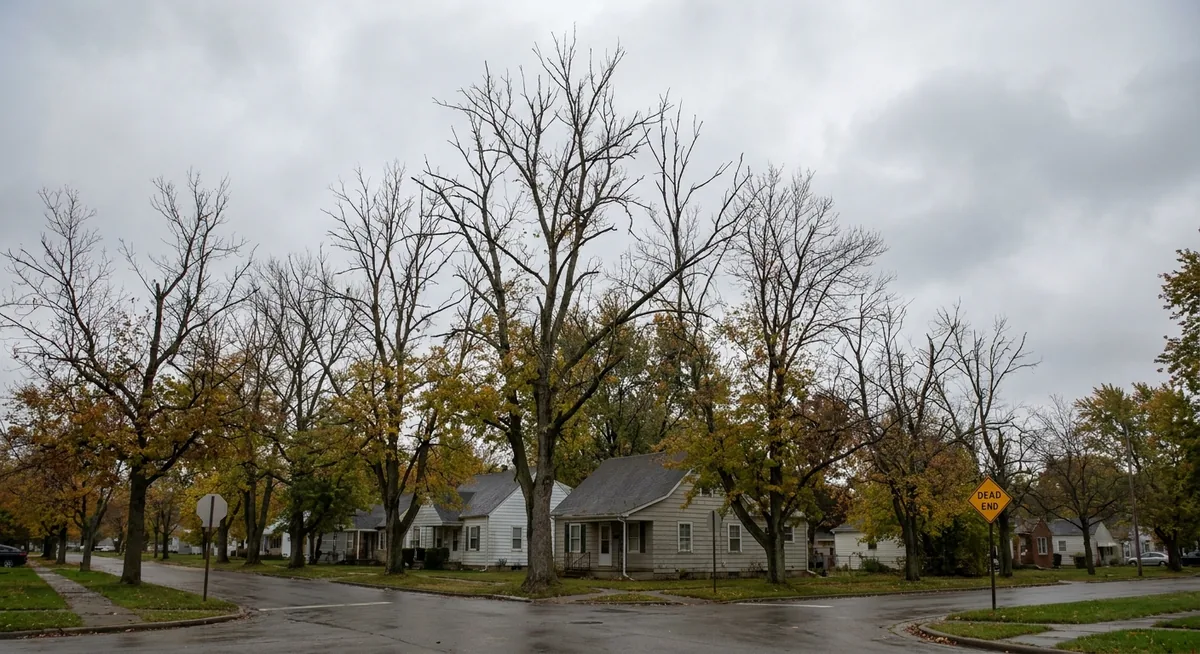
If you’ve lived in Toledo or the surrounding area for the past fifteen years, you’ve watched it happen — ash trees along roadsides, in parks, and in backyards progressively dying. Some neighborhoods have lost nearly every ash they had. The culprit is emerald ash borer (EAB), an invasive insect from Asia, and northwest Ohio has been among the hardest-hit regions in the country.
What Is Emerald Ash Borer?
Emerald ash borer (Agrilus planipennis) is a small metallic green beetle, roughly the size of a grain of rice, that was accidentally introduced to the United States in the early 1990s through wood packing materials from Asia. It was first confirmed in Michigan in 2002 and spread rapidly from there.
The beetle itself doesn’t kill the tree — its larvae do. After adults lay eggs in bark crevices, the larvae bore into the inner bark and phloem, the layer just beneath the bark that transports nutrients and water throughout the tree. They create winding galleries as they feed, effectively girdling the tree and cutting off its circulatory system. Once the infestation is established, it’s fatal.
Why Northwest Ohio Was Hit So Hard
Ohio’s ash trees were particularly vulnerable for a few reasons:
Ash was overplanted. In the 1970s and 80s, Dutch elm disease wiped out most of the American elms that had lined city streets across the Midwest. Municipalities and homeowners replaced them — often with ash, since it was fast-growing, tolerant of urban conditions, and widely available. Toledo, like many Ohio cities, planted enormous numbers of ash trees. When EAB arrived, it found dense concentrations of host trees rather than scattered individuals.
Ash makes up a huge percentage of Ohio’s forest. Ohio had over 3.8 billion ash trees before EAB. The sheer number of host trees meant the beetle spread explosively once it got established.
EAB moves fast, kills fast. A healthy-looking ash tree can be dead within 2-4 years of initial infestation. By the time most homeowners noticed symptoms, the tree was already past saving.
How to Identify EAB Damage on Your Ash Trees
S-shaped galleries: If you peel back bark from a dying section of an ash tree, you’ll find distinctive S-shaped feeding channels left by the larvae. This is the most definitive sign.
D-shaped exit holes: Adult beetles emerge through D-shaped holes, about 1/8 inch wide, in the bark. These are smaller and more distinctive than round woodpecker holes.
Epicormic sprouting: As the tree dies from the top down, it often pushes out clusters of shoots from the lower trunk and major limbs — a stress response that’s characteristic of EAB infestation.
Crown dieback: The canopy dies progressively from the top and outer edges inward. If you see significant thinning or dead branches concentrated in the upper crown, EAB is a likely cause in this region.
Woodpecker activity: Woodpeckers go after EAB larvae aggressively. Heavy woodpecker damage — lots of rectangular or irregular bark removal — on an ash tree is often a sign of a serious EAB infestation below.
Do You Have Ash Trees?
Ash trees have compound leaves — a central stem with 5 to 11 leaflets arranged opposite each other. The bark of mature trees has a distinctive diamond-shaped ridge pattern. If you’re not sure whether a tree on your property is an ash, take a few photos and send them to us or check with the Toledo-Lucas County Cooperative Extension office.
Your Options If You Have Ash Trees
Option 1: Remove it. For most ash trees in the Toledo area, especially those that are already showing symptoms or are over 15 years old, removal is the realistic and safe choice. A dead ash tree loses structural integrity relatively quickly — the wood becomes brittle and unpredictable, making removal more difficult and expensive the longer you wait.
Option 2: Treat it. For ash trees in excellent structural condition with minimal crown dieback, systemic insecticide treatments can protect against EAB. The most effective treatments use emamectin benzoate (trunk injection) or dinotefuran (bark spray) — not the cheaper over-the-counter soil drench products. Treatment has to begin before significant damage occurs and must be repeated on a schedule. It’s worth doing for a large, structurally valuable tree, but it’s not a permanent fix and isn’t appropriate for trees that are already heavily infested.
Option 3: Do nothing. We understand the economics of this — removal costs money. But a dead ash tree doesn’t hold its structural integrity for long. Heavy branch falls are common from dead ash trees, and a large ash can take out whatever is below it. If the tree is near your house, your car, or a place where people walk, doing nothing has real risk attached to it.
What to Do Next
If you have ash trees and haven’t had them evaluated, now is a good time. Contact Glass City Tree Service for a free assessment in Toledo and surrounding northwest Ohio communities. We can help you determine which trees are viable candidates for treatment and which ones need to come down.